Marc Watkins
University of Mississippi
This chapter discusses the integration of generative AI (GenAI) in education, particularly in first-year writing courses. Recognizing the transformative potential of GenAI, the assignment proposes framing principles to guide students towards ethical and responsible AI use in an assistive role. Two assignments were developed using AI-powered tools upgraded to GPT-3.5 or GPT-4 to help students explore research and counterarguments.
Learning Goals:
- Use AI-powered assistants to explore research and counterarguments
- Articulate differences between AI-assisted and AI-generated writing through developing and using AI Standards of Conduct
Original Assignment Context: First-year writing course
Materials Needed: An accessible AI text generation program (i.e. ChatGPT)
Time Frame: 1-2 class sessions
Introduction
Employing generative AI in education is an emergent practice that has the potential to transform education and learning, but doing so requires thoughtful integration, training, and aligning the technology with clear learning outcomes. We’re a long way from establishing best practices around GenAI, but I do believe we can set some framing principles to help students explore the technology in an assistive role to guide students toward ethical and responsible use of the technology. To this end, I developed the following two assignments to help first-year writing students use AI-powered assistants to explore research and counterarguments. Both assignments used tools powered by GPT-3 and both tools have since upgraded to GPT-3.5 or GPT-4.
In collaboration with Dr. Chad Russell, the Department of Writing and Rhetoric’s Assessment Coordinator, we developed an initial framework, "AI Standards of Conduct", that differentiated AI-assisted and AI-generated writing. Recognizing the evolving nature of AI, we viewed this as a foundation for future student-inclusive policy development. Students responded positively to this structured, assistant-focused approach, which facilitated a healthy relationship with the technology.
To promote ethical AI use, I took a cautious approach in assignment design, focusing on areas where students typically struggled. We used AI tools like Fermat’s counter-argument generator and Elicit’s Brainstorm Research question. These tools, combined with careful design, encouraged student exploration and reflection on the role of AI in their writing process.
The Assignments
AI Standards of Conduct Framework
AI-Assisted Writing vs. AI-Generated Writing
With the rise of AI writing assistants, students must take special care to ensure that they use this new technology ethically and honestly. In our class, we will distinguish between ‘AI-assisted writing’ versus ‘AI-generated writing’. AI-assisted writing is only permitted in this course provided a student uses an AI writing assistant as a collaborative tool to help the student with the development and advancement of their own writing process. Collaborating with an AI writing assistant can include brainstorming, outlining, and drafting, so long as there is substantial writing, research, and composing by the student which is not generated solely by the AI. ‘AI-generated writing’ means there has been little or no involvement from the student as an author, with the majority of the writing being generated by an AI. The goal of using AI-assisted writing in this class is to help students develop their writing process and critical thinking, not to replace or substitute for either. Therefore, using an AI to generate writing or compositions without substantial original contribution from a student is neither acceptable nor allowed.
|
Acceptable
|
Not Acceptable
|
|
AI-Assisted Writing
|
AI-Generated Writing
|
- Use AI-assisted writing to brainstorm
- Explore new topics/ideas with AI-assisted writing
- Use AI-assisted writing to explore potential counterarguments/ opposing points of view
- Resee your writing by taking suggestions from your AI assistant to make improvements
|
- Offload the majority of the writing & research process to AI
- Generate large chunks of text with little or no input from you as an author
- Trust something the AI has generated at face value
- Use AI-generated text as a substitute for research or critical thinking
|
AI Literacy is not yet clearly defined or broadly understood. By experimenting with these generative AI systems, students will increase their awareness of the limitations and affordances offered by this technology. Please be certain to approach your instructor in each class and enter into a conversation with them about their own AI framework before using a tool.
Be Aware
- You will not be able to save anything the AI generates. If you want to use an idea or suggestion produced by the AI, you will need to copy and paste it into a Word.doc.
- The AI output may contain material that is offensive, biased, or otherwise goes against the University Creed in practice, or material that is false or misleading or potentially harmful, or other problematic material the use of which may fall outside the protections of Academic Freedom and/or Free Speech–review all AI output carefully before using anything suggested by the AI within your academic work.
Fermat-Brainstorming Counterarguments
FYW students used Fermat’s GPT-3 powered tools to develop an outline mixing their own writing withAI generated content from the app’s counterargument tool.
Table Contents
- Brainstorming Counterarguments Assignment
- Assignment Example
- Reflection Instructions
Reference
Roig, Oriol. “Bringing an AI Partner.” Fermat, docs.fermat.app/creating-your-own-tools/bringing-an-ai-partner. Accessed 21 July 2023.
|
Brainstorming Counterarguments Assignment
|
|
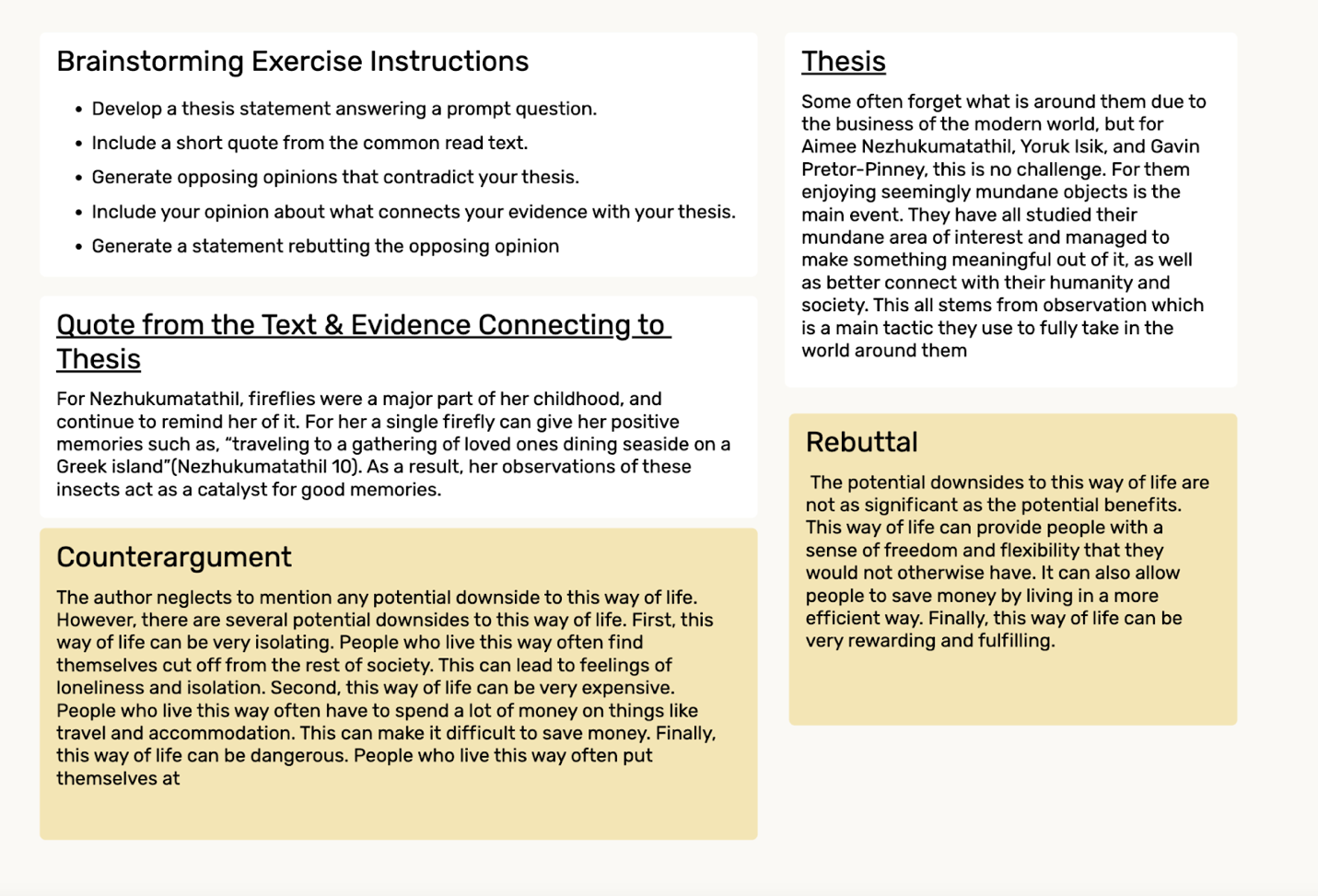
This critical thinking exercise is a self-assessment and is designed to help you with the Common Read essay. Please use our AI Writing Assistant to help you with this task.
Directions
Select one of the prompts from the Common Read Unit Assignment Directions to compose your response. Your response should be between 250 to 300 words. Include the following information in your response.
- Write or use our AI Writing Assistant to develop a thesis statement answering the prompt question.
- Find and include a short quote from the common read text.
- Use our AI Writing Assistant to explore opposing opinions that contradict your thesis.
- Write your opinion about what connects your evidence with your thesis.
- Use our AI Writing Assistant to explore claims rebutting the opposing opinion..
Submission & Self-Assessment
Once you have written your response, take a screenshot or copy the material to a word.doc and submit it to Eduflow by clicking on the title of this Blackboard post and follow directions to complete the self-assessment.
|
|
Assignment Example
|
|
|
|
Reflection Instructions
|
|
Directions
Use these questions as a starting point in this reflection, but feel free to move beyond them as you write and reflect. Your reflection should be at least 250 words long.
- Identify one area of the brainstorming assignment that was helpful to your learning process. Why did you select this area of the assignment? How was it helpful to your learning?
- Was using Fermat’s AI-Writing assistant helpful in completing the assignment? Why or why not?
- Was it difficult finding evidence to support your thesis?
- What new information did you learn about your topic by generating counterarguments using our AI assistant?
- What information do you feel like you still need to know in order to write your essay?
|
Elicit-Brainstorming Research Questions
FYW students used Elicit’s Brainstorming Research Questions task to develop a main research question and sub questions to help them explore more about their topics their argumentative research essays.
Table Contents
- Brainstorming Research Question Assignment
- Assignment Example Generated by GPT-3
- Reflection Instructions
Reference
“Brainstorm Research Questions.” Elicit.org, elicit.org/tasks. Accessed 21 July 2023.
|
Brainstorming Research Question Assignment
|
|
Step One
Review the main Argument Unit directions to ensure you are picking a topic that fits the assignment.
Step Two
Sign up and create a free account with Elicit using your go.olemiss.edu credentials, then click here to access the Brainstorming Research Questions tool.
Step Three
Enter topics you want to explore into Elicit’s Brainstorming Research Questions tool and pick and choose which ones you’d like to explore further. You can star responses and generate more ones like the question you’ve selected.
Step Four
Create your Research Question proposal by selecting a main overall research question and several sub-questions from Elicit. Then use your own writing to shape the proposal following the directions below. You can review the Research Question Student Example.
Requirements
- Must fit within the guidelines outlined in the Research essay directions.
- Minimum of 100 words (standard font, spacing, and margins), double spaced.
- Some background about what makes this a good research topic.
- Must include a creative and descriptive title appropriate for your project.
- Must contain your main research question.
- Include a number of sub-questions you might wish to explore related to your main research question
Evaluation
10 points of your Research project.
|
|
Research Question Student Example
|
|
Title
The Impact of Social Media on Young People’s Mental Health
Main Research Question
How does social media use impact mental health in young people?
Proposal
This is an important question to explore as social media becomes increasingly prevalent in young people’s lives. There are many potential factors to consider, such as the amount of time spent on social media, the types of content that is consumed, and whether young people have a supportive social network offline. This research question can be explored through surveys, interviews, and focus groups with young people. I plan to use a combination of scholarly sources and pop culture sources to help explore my topic in depth. I will need to balance any biased opinions I have about social media and mental health in order to keep an open mind about my topic. I ultimately hope to explore sources and arguments that will shape my opinion.
Subquestions
- How does the amount of time spent on social media impact mental health in young people?
- How does the type of content consumed on social media impact mental health in young people?
- Do young people who have a supportive social network offline have better mental health?
- How does social media use impact mental health in young people with pre-existing mental health conditions?
- How does social media use impact mental health in young people from different socio-economic backgrounds?
- How does social media use impact mental health in young people from different cultural backgrounds?
|
|
Reflection Directions
|
|
Respond to the questions below about the Research Question assignment. Your post should be about 200-250 words long in the first-person, past tense.
- Have you ever used this tool or a tool like Elicit in your writing or learning processes? If so, please explain your experience.
- What was your initial reaction to using Elicit? How did it impact your writing/thinking process?
- How did using Elicit differ from your normal writing/thinking process?
- How did Elicit impact the formulation of your research question?
- Did Elicit provide information you had already considered or were the ideas new to you?
- Part of the research process is to keep an open mind. How do you plan on keeping an open mind at this point in the research process and not being swayed by personal opinions or biases that you have?
|